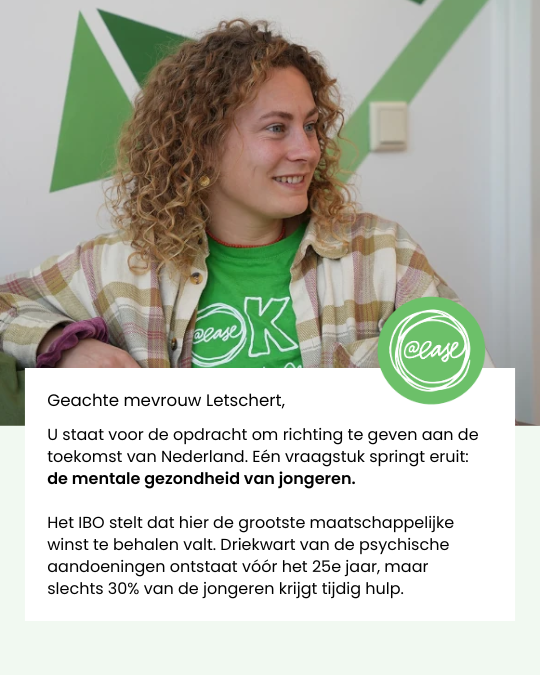
Dear Ms Letschert,
You’re helping shape the future of the Netherlands. And there’s one issue that really stands out: young people’s mental health.
The IBO says this is where we can make the biggest social difference. Most mental health issues — 75% — start before age 25, but only 30% of young people get help on time. And young people are speaking up: what they need is still missing, easy-to-access, youth-friendly support in places they feel safe, with help from peers who understand them.
Even the National Institute for Public Health and the Environment (RIVM) and the Trimbos Institute confirmed again this week that young people’s mental health is continuing to deteriorate, mainly due to a lack of timely support and appropriate first-line care.
We’re asking you to make youth mental health a top priority. Not another one-stop-shop, but a real first-stop: an easy place to walk into, where young people talk to someone their age and figure out together what would help. It should be local, connected to the support that’s already there, and built around what young people actually need.
These kinds of first-stop places already exist, and @ease is one of them. It works: we help spot problems early and often prevent the need for heavier care. In 2025, the OECD even named @ease one of the best in the world when it comes to what works, what’s affordable, and what you can scale up.
This could be scaled up across the country tomorrow. It takes pressure off doctors and youth care, fits with AZWA’s goals, and it’s financially responsible within current mental health and prevention budgets. It’s exactly the kind of smart, practical solution a new government is looking for.
We’re asking you to make youth mental health a top and lasting priority in the new coalition agreement, starting with these key choices:
- A promise across the country: every young person should be able to get easy, safe, and direct mental health support, like the proven first-stop approach we use at @ease.
- Steady and reliable funding through existing prevention and mental health budgets, so that good support doesn’t have to stop when project money runs out.
- Building strong, preventive support for young people, together with schools and local communities. Focused on spotting problems early, boosting resilience, and getting the right help on time.
Ms Letschert: helping young people doesn’t have to be complicated. We’ve got the know-how, the people, and initiatives that work. Now we just need the political support to make it happen.
Young people don’t just need easy access to help, they deserve a say in how that help works. You’re very welcome to come visit @ease and see how we do this together with young people.
On behalf of the board, the team and all volunteers of the @ease foundation,
Arianne Westhuis (director of @ease) and Prof. Dr. Thérèse van Amelsvoort (professor at Maastricht University and one of the co-founders of @ease)