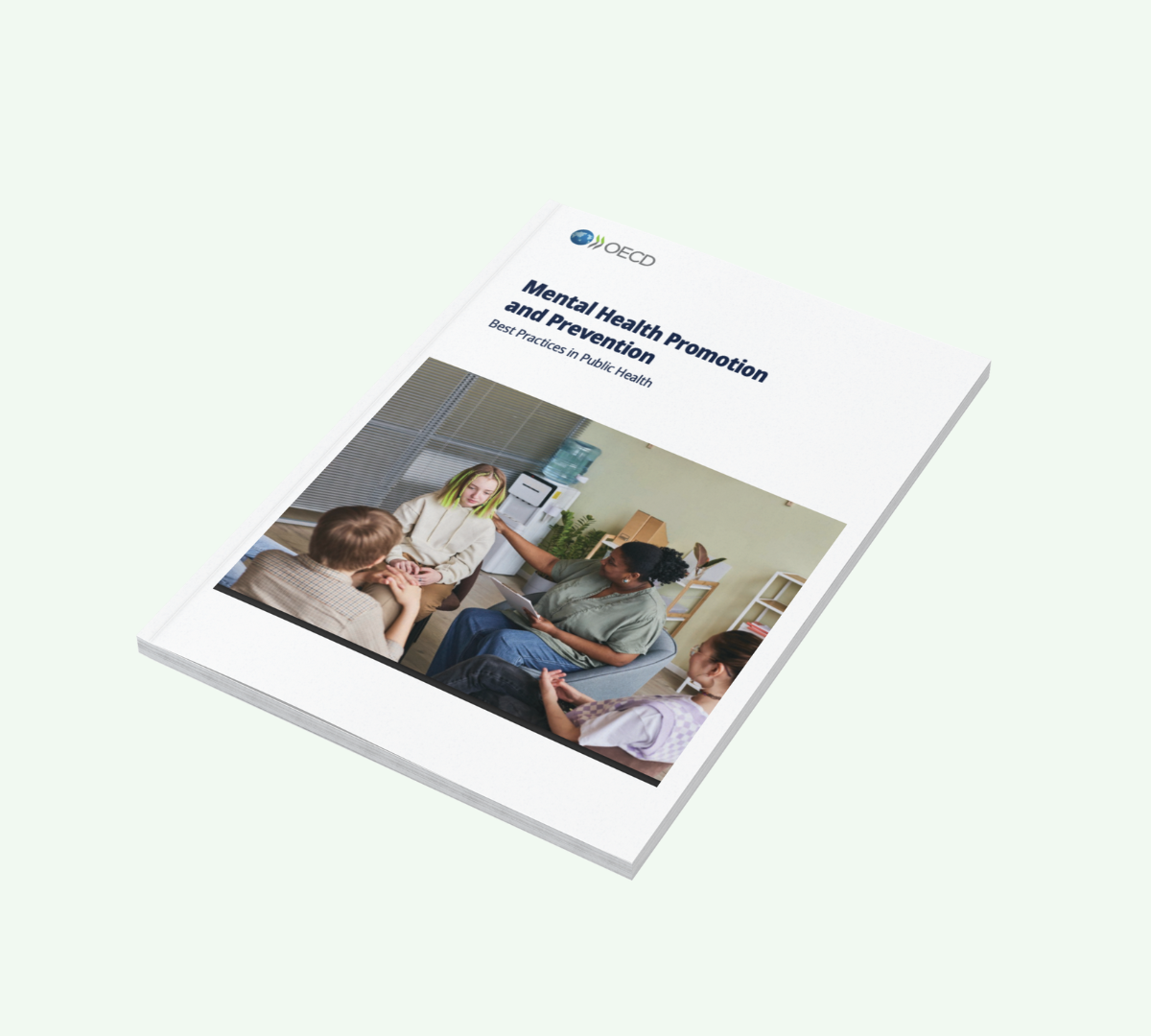
We’re proud! The OECD has recognised @ease as one of 11 best practices for youth mental health, across 65 countries. In their 2025 report Mental Health Promotion and Prevention: Best Practices in Public Health, @ease is highlighted as a proven, effective and scalable intervention
The OECD doesn’t just recognize us, they encourage governments to invest in initiatives like @ease. And that’s great news. Because the earlier you talk, the bigger the chance you stay on your feet. It’s exactly what we believe in: accessible, no-pressure support that helps strengthen your mental resilience and can prevent bigger struggles later on.
What does OECD say about @ease
The OECD puts it in black and white: @ease works. Young people feel seen and heard in conversations with peers. They can drop in easily, and if more help is needed, we’re well connected to local support. That’s the power of @ease: the unique combination of peer-to-peer conversations.
Why does OECD call this a best practice?
According to the OECD, @ease is a best practice because it:
- has a clearly proven positive impact on reducing mental health complaints in young people, with noticeable improvement after an average of just two conversations;
- reaches young people who are often left out of the regular healthcare system;
- successfully uses peer support as a form of early, informal assistance;
- is well embedded in local networks and allows for referral if further care is required;
- is supported by scientific research and systematic monitoring;
- is easy to implement in other contexts due to the modular and flexible nature of the approach.
This combination of (cost)effectiveness, accessibility, and transferability makes @ease, according to the OECD, a valuable addition to existing care structures.
What is the OECD?
The OECD (Organisation for Economic Co-operation and Development) is an influential international organisation with 65 member states (38 OECD countries and 27 EU member states), focusing on Europe and other high-income countries.
The organisation supports governments with policy advice based on scientific analysis and data on topics such as education, economy and health. OECD reports are used worldwide by policymakers, researchers and care organisations.
Research period and selection process
The selection of best practices took place between 2022 and 2025, in collaboration with the European Commission and national experts. The assessment was carried out by the Expert Group on the Economics of Public Health. Preliminary analyses were discussed in 2024; the final report was approved in June 2025.
Interventions were submitted by member states or through the EU Best Practices Portal. The selection was content-driven and based on criteria such as effectiveness, transferability and societal relevance within the OECD/EU context.
@ease scored highly on all points.
This report presents a clear mandate for policymakers, municipalities and funds: support and scale up what works.
Want to know more?
- Read the full OECD report via this link
- Or contact us at info@ease.nl for more information